Section 06 / Food Experience 07 / Bakers · Halloween
06.07
Lagkagehuset.
The bakers’ entry: Lagkagehuset’s Køge bakery on Rådhusstræde, a few steps from the square, bread and kanelstænger from half past six. And in October a counter of Halloween cakes — a pumpkin flødebolle, a bat, a mummy, a monster, a witch and two ghosts, 30 kroner each — printed here as a specimen sheet.
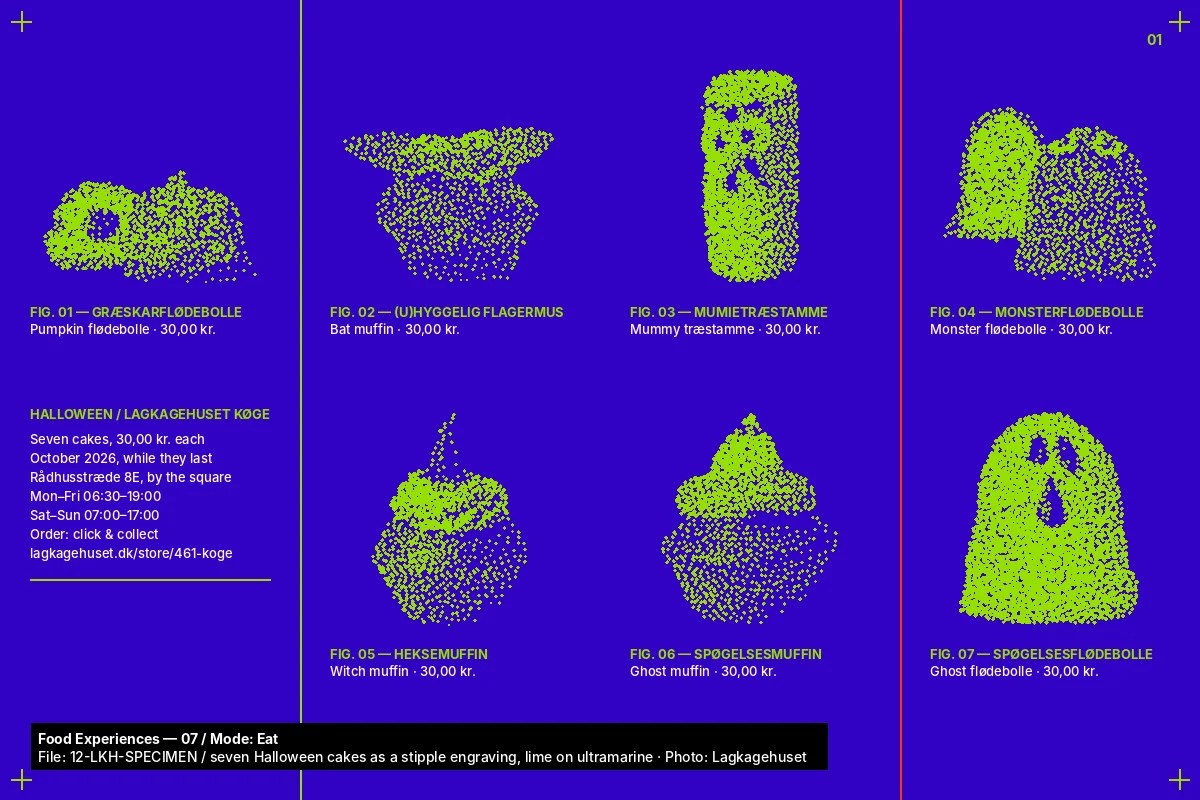
Location: Rådhusstræde 8E, the counter in October · Photo: Lagkagehuset
File: 12-LKH-SPECIMEN / seven Halloween cakes as a stipple engraving
The baker
The flødeboller grow eyes in October.
Lagkagehuset is the chain that taught Denmark to queue for bread. Ole Kristoffersen and Jane Borup opened the first bakery in 1991 on the ground floor of a 1930 block on Christianshavns Torv in Copenhagen whose cream and white storeys look like a layer cake — hence the name; Lone and Steen Skallebæk ran a bakery in Haderslev with the same idea, and in 2008 the two became one. Today it is Ole & Steen in London and New York and Lagkagehuset all over Denmark, three thousand colleagues in three countries. Køge’s is on Rådhusstræde, a few steps from Torvet: bread, pastries and coffee from half past six on weekdays, seven at the weekend, and a webshop that lets you order the night before and collect at the counter.
In October the counter turns. Seven Halloween cakes, thirty kroner each: a pumpkin flødebolle in orange coconut with a caramel centre; a bat — a chocolate muffin with wings and eyes of chocolate; a mummy træstamme of rum truffle and raspberry “blood” under white chocolate; a monster flødebolle in purple coconut over blackcurrant foam; a witch muffin — carrot cake under orange cream with a marzipan hat; a ghost muffin with blueberries, purple cream and a meringue ghost; and the ghost flødebolle itself, a classic on a marzipan base under white chocolate, with eyes and a mouth of dark chocolate. The seven are printed above as a specimen sheet, each as a stipple engraving, lime on ultramarine.
Where
Lagkagehuset Køge, Rådhusstræde 8E, 4600 Køge — a few steps from Torvet.
When
Monday to Friday 06:30–19:00, Saturday and Sunday 07:00–17:00.
Halloween
Seven cakes, 30,00 kr. each, in the shop and on the webshop under “Halloween” — October 2026, while they last; no end date is published.
The seven
Græskarflødebolle, (U)hyggelig flagermus, Mumietræstamme, Monsterflødebolle, Heksemuffin, Spøgelsesmuffin, Spøgelsesflødebolle.
Ordering
Click & collect through lagkagehuset.dk: pick the Køge shop, pick a day, pay online, collect at the counter. Questions by phone, +45 70 70 50 14, or e-mail to koege@lagkagehuset.dk.
The chain
Founded 1991 on Christianshavns Torv, named after the layer-cake building of 1930 by Edvard Thomsen; one with Skallebæk’s Bageri of Haderslev since 2008; Ole & Steen in London since 2016 and in New York since 2019.
Bakers
The other baker in this section is Organic Market on Vestergade — Food Experience 04 — unmanned, 07:00–23:00. Two bakers, two ways: a counter with people behind it, and a door that opens for an app.
Source
lagkagehuset.dk — the Køge shop page and “Hvem er Lagkagehuset?”, read 10 October 2026. The seven product photographs are Lagkagehuset’s, used here for concept demonstration only.
Back: Section 06 / Food Experiences

